
2024 Update: Check your airline’s policies.
A note: These tips all apply to flying United in 2017 with a parrot. I learned the hard way in 2020 that airline policies regarding in-cabin pets change all the time. Make sure you call ahead and do research on the recent policies to ensure that your flight will even allow pets–and birds especially– to begin with.
Flying on an Airplane with my Parrot
Once upon a time, a crazy parrot lady (me) thought it’d be a good idea to take her parrots a-traveling with her on an airplane. One would fly with her in the cabin, and one would fly via United’s Former Pet Safe Program (recently no longer accepts parrots), or as I’ll refer to it, in “steerage”.

Because it was just me, myself, and I (traveling alone), I was only allowed to bring one bird into the cabin with me; if I’d had a friend, we could have brought both and stuck them both under the seats in front of us, provided other animals weren’t already taking up the limited amount of animal space on the flight. Since I couldn’t fit them both under my seat in one cage, I had to pick which one would fly with me, and which bird would fly “steerage.”
My Ekkie, Louie, is a little more sensitive than Vi the Amazon–I once boarded him and had him groomed in the same few days, and once we took him home, he vomited from stress all night long.
Thus, Louie was the lucky bird I took with me in the cabin of the actual airplane.
Before You Go: Carriers/Preparation
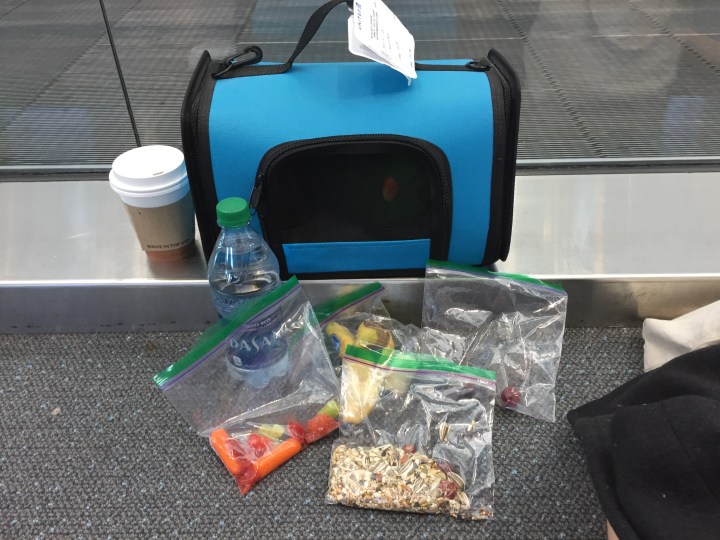
The carrier pictured above is the Kaytee Come Along Carrier, Medium, Assorted Colors
Note that it absolutely MUST fit under the seat in front of you; they’re technically supposed to stay under your seat the entire flight.
For this reason, I recommend soft-sided carriers – they’re allowed to be a lot bigger (“18 inches long x 11 inches wide x 11 inches high” and are allowed to exceed these dimensions slightly since, “they are collapsible and able to conform to under-seat space without blocking the aisle”).
Meanwhile, hard-sided carriers are allowed to be only “17.5 inches long x 12 inches wide x 7.5 inches high” (source). Note that other airlines might have different size requirements, so definitely remember to ask about parrot carrier airline size requirements when you call to book your birdy’s flight!
The Day Of: What To Bring in your Carry-On for the Cabin For Your Parrot
- Extra paper towels. You don’t need the whole roll, but you’ll probably want to clean your bird (and his carrier) up before and after the flight.
- A Packet of Wet Wipes
- Baggie full of their favorite dry treats.
- Baggie full of Pellets/regular diet.
- Water-rich foods to feed intermittently, such as grapes, carrots, celery and apple slices. (I took mine in a plastic baggie through security).
- A few small food bowls (two or three is fine) if you want to change out food and water before and after the flight.
- DON’T bring a full bottle of water for your birdy; you’ll have to throw it away when you go through security.
Parrot Airport Check In – Arrive Early.
- Everyone is going to want to see what kind of “dog” you have. Pets on planes are kind of rare–it takes even longer when they realize you have an unexpected birdy companion! People will stop you and ask you about your bird constantly, so add an extra half hour to an hour to accommodate for this.
- Plan on going to the ticket counter, not a kiosk.
- Your pet will need their own boarding pass, which only the people behind the counter can print for you.
Going Through Airport Security With Your Parrot
- You may have to go through a separate gate for security. At DIA, they frequently have drug and pet-sniffing dogs on duty; the scent of your parrot can throw the dogs off, so make sure you chat with whoever is directing traffic at the security line before you actually get in line. Alert them to the fact you have a birdy friend with you to make sure this is the right security checkpoint to go through.
- You have two options for going through security:
- Take your bird out and walk him or her through a metal detector, or
B. Ask for a private screening, where you will still need to take your bird out.
- Take your bird out and walk him or her through a metal detector, or
Scary news: Your bird is going to have to come out of their carrier. Period. Thus, ensuring your bird is harness trained is the safest way to make sure you don’t lose your bird in the airport.
Walking Through Security’s Metal Detector With Your Parrot
If your parrot is super well-behaved, you have the option to take him or her out in the middle of the security line and just walk through a metal detector.
They swabbed my hands for illegal substances, so you’ll have to pass your bird from one hand to another, but that’s all they did for me. No one took Louie from my hands (I held him the whole time) or touched him, but that doesn’t mean they wouldn’t for you.
Getting a Private Screening with your Parrot
If your parrot isn’t the best behaved or is easily stressed out, ask for a private screening. You’ll be escorted to a room where you will still very likely be asked to take your parrot out of his or her carrier.
Warning: Your Private Screening May Take Place In A Cubicle, Not a Room
Update from 2024: I semi-recently brought my cockatiel on a plane and, due to the nature of his rescue, his wings were not clipped and I was unable to harness train him prior to getting to the airport. I assumed security would take us to a room–nope. It was a cubicle, with no roof, in DIA. For those of you haven’t traveled through Denver, it is a GIANT CIRCUS TENT.
Nightmare of nightmares: They asked that I take my fully flighted cockatiel out of his cage. If my beloved QTip got loose, I would never see him again. Why? They needed to swab his carrier, top to bottom. Something set off their alarm.
Ultimately, we made it through security with no mishaps–I VERY CAREFULLY grabbed him using a towel I had brought and held onto him for dear life. It was the most harrowing bird parront experience I’d had to that point.
So, please learn from my mistakes:
You should absolutely know that whether you go through security or ask for a private screening, you almost guaranteed will have to take your parrot out. If your parrot is even somewhat flighted, they might disappear into the airport, never to be seen again.
Be prepared. Harness train your baby.
After Security
- Buy a bottle of water after security to keep your friend hydrated through the flight.
- Prior to boarding the flight, ensure your parrot’s papers are clean, replacing with paper towels as necessary.
- Check that your feathered friend has plenty of food and water, as it may have sloshed out during your trek from parking lot to gate.
Traveling With Parrots During the Flight:
- Your parrot will not be allowed to come out of his or her cage for the duration of the flight.
- If you have a hoodie or brought a towel with you, you might consider covering them in their cage to keep them calmer.
That’s it! The hard part is done!
Final Tips and Tricks for In-Cabin Parrot Travel
Arrive EARLY (Allow 3.5 hours instead of the standard 2 hours before-hand): If you want to take your feathered friend with you in the airplane cabin, I’d call ahead as early as possible, as only four pets are allowed in the cabin on any one flight. It’s not super common, but it’s important to consider. Additionally, some airplanes don’t have the appropriate legroom, so you’ll want to check what kind of plane you’ll be on ahead of time–the easiest way is to just call your airline when you book your parrot’s ticket.
Contortionist: Parrots take your under-the-seat space. You will need to be a rather flexible person to do this, or it’s recommended that get an aisle seat; it’s not a comfortable ride since your feathered friend will take up a ton of leg room.
Small bird owners, you can carry two small birds in the same carrier with you; if I’d taken two cockatiels, for example, I’d have them share a carrier on my flight. I would have had to take both of them out for security though, at the same time, so… forewarning.
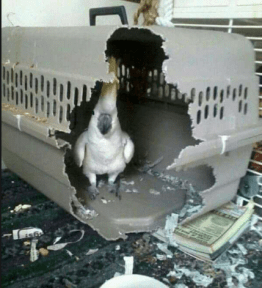
Cockatoo owners, I have bad news: your cockatoo isn’t allowed in the cabin. I’m sure this doesn’t exactly surprise you, since the soft fabric you need to fit under the seat won’t stand a chance.
Our Happy Ending
Overall, Louie had no problems during the entire flight. He didn’t make a sound; at one point, I was a little concerned at how quiet he wasso I opened his door a crack to check on him, and he tried to crawl right out (the guy next to me was not amused). Probably best to keep the carrier shut once you’ve boarded the plane. 🙂
There you have it! Airplane travel in a nutshell.


Sarah!
This is wonderful and insightful information that all parrot parents need to know! Thanks for sharing! 🙂
LikeLiked by 1 person
Seemed like a must read… even though I don’t own a bird — let alone travel with one. Love a good bird story though. 🙂
LikeLike
can we reblog?
https://centralfloridaparrotsanctuary.com/
LikeLike
Hi! Absolutely you can — I would appreciate a link back to this blog, but you’re welcome to reblog it in full or in part. Thank you for asking!
LikeLike